Proof of You: How Phēnix X Is Building the Future of Trusted Identity
As AI makes it easier to fake who someone is online, proving your identity is becoming one of the most important things a smartphone can do. The Phēnix X, powered by BioFi, uses Say-Tec biometric authentication (face, voice, and other security tools) directly on the device, backed by the BioFi ecosystem, to give users a stronger foundation for protecting their accounts, assets, and personal information.
What does “proof of you” mean?
Every time you unlock your phone, open a banking app, send money, or sign in to an account, you answer one question: are you really you?
For most of the internet’s history, the answer was a password. Then it became a password plus a code sent by text message. Today, those methods are showing their age. Passwords get stolen, codes get intercepted, and AI tools are making impersonation cheaper and easier than ever.
The next generation of digital life needs a better answer. We call it proof of you: identity that belongs to the person, lives on the device they carry, and cannot be handed over as easily as a password.
Why is identity fraud growing so fast?
AI has changed the economics of fraud. Tools that once required skill and money are now widely available, and criminals are using them at scale.
The numbers from across Africa are striking. According to Smile ID’s 2026 Digital Identity Fraud Report, in Southern Africa, almost nine in ten rejected biometric verification attempts were connected to AI-assisted impersonation and spoofing.
The growth has been rapid: Southern African deepfake attempts rose from fewer than 200 per month in 2024 to more than 3,000 per month by the end of 2025. Interpol’s figures tell a similar story, with AI being a component in 55 percent of reported cybercrimes in Africa during 2025. 87% of failed biometric verifications in Southern Africa due to AI spoofing.
This is happening just as more people come online. Africa’s share of adults owning a financial account has risen from 34 percent to nearly 60 percent over the past decade. Smartphone adoption in Sub-Saharan Africa sat at 54% in 2024 and is forecast to reach 81% by 2030. Every new account and every new phone is a step toward opportunity, but it is also a new target.
Why is the phone now the front line?
Fraud has moved closer to the device itself. Researchers report that fraud networks now manipulate operating systems, mobile devices and verification sessions to bypass detection, rather than simply falsifying an ID document or photo.
That shift matters. If the phone is where identity is captured, checked, and used, then the phone has to be built with identity in mind from the start. Security cannot be an app added later. It has to be part of the foundation.
How does Phēnix X protect your identity?
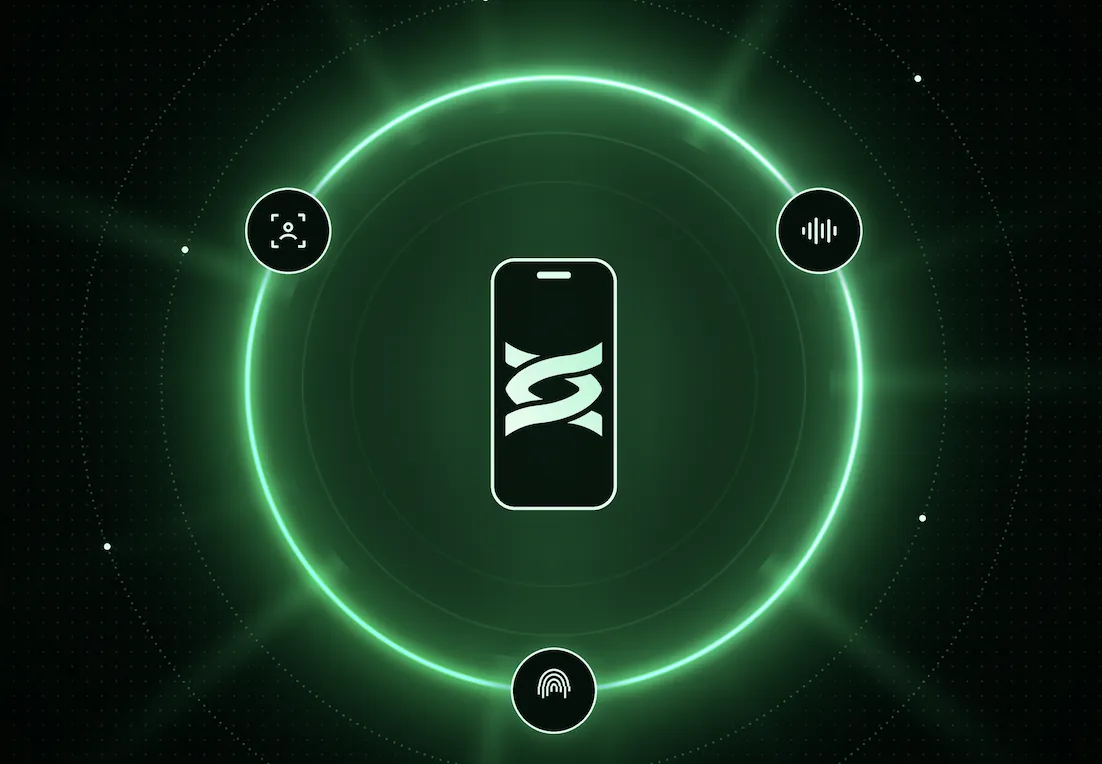
The Phēnix X was designed for this moment. Every device uses Say-Tec biometric authentication, which combines multiple ways of recognizing its owner: face, voice, fingerprint, and blockchain and cryptographic validations.
Each method adds a different layer. Your fingerprint offers fast, familiar access for everyday use. Your face adds visual recognition. Your voice adds another personal signal that is unique to you. Blockchain and cryptographic validations extend into the frontiers of AI. Together, they give the Phēnix X more than one way to confirm that the person holding the phone is its rightful owner before it unlocks wallets, apps, personal information, or financial transactions.
Just as important is where authentication happens. On the Phēnix X, biometric checks take place directly on the device rather than relying on passwords stored in centralized systems. That means fewer vulnerable passwords to remember and fewer central databases that attackers can target to steal credentials in bulk.
Where does BioFi fit in?
A strong device is the first step. The BioFi ecosystem extends that trust further.
BioFi is a full identity ecosystem built around the Phēnix X, with biometric security in the hardware and a suite of apps connected by the $BioFi utility token.
Tools like PhēnixLoc bring that same security posture to everyday life. PhēnixLoc secures passwords, files, banking details, and wallet recovery phrases with decentralized double encryption and blockchain technology, so the most sensitive parts of your digital life stay under your control.
What comes next for trusted identity?
The Phēnix X is only the beginning. The wider Phēnix X family, including the Phēnix XT tablet, Phēnix X Watch, and Phēnix X Smart Glasses, is built on the same principles of secure access and digital authentication.
Imagine an ecosystem where your phone, your watch, and your glasses work together to recognize you, where your identity moves with you across devices, and where proving who you are becomes both simpler and stronger. That is the direction BitMobile and BioFi are building toward.
Across Africa and other emerging markets, millions of people will enter the digital economy in the next few years. Many of them will skip the password era entirely. Their first bank, wallet, and digital identity will live on a mobile device. The question is whether that device was built to protect them. The Phēnix X was.
Frequently asked questions
What biometrics does Phēnix X use?
Phēnix X uses Say-Tec biometric authentication, which recognizes its owner through face, voice, fingerprint, and other security tools.
Where is my biometric information checked?
Authentication happens directly on the Phēnix X device rather than through centralized password systems. Blockchain and cryptographic validations extend into the frontiers of AI to ensure the most advanced security protocols.
What is $BioFi?
$BioFi is the utility token that connects the BioFi ecosystem, including its security services and financial tools.